Thyroid nodules are common, and while many are harmless, some can grow large enough to cause discomfort, swallowing difficulty, cosmetic concerns, or hormonal problems. Traditionally, surgery was considered the primary treatment for symptomatic thyroid nodules. However, advancements in Interventional Radiology have introduced Thyroid Ablation, a safe, effective, and minimally invasive alternative that preserves the thyroid gland.
This comprehensive guide explains everything you need to know about Thyroid Ablation, including the procedure, benefits, recovery, eligibility, and why it has become a preferred treatment option for suitable patients. If you’re searching for complete information about Thyroid Ablation Benefits & Recovery, this guide will answer all your questions.
What is Thyroid Ablation?
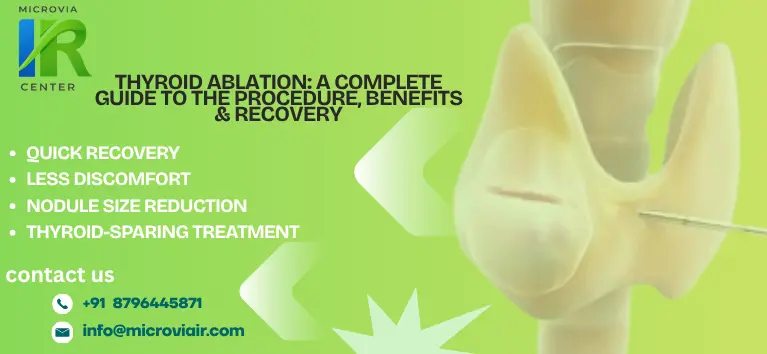
Thyroid Ablation is a minimally invasive procedure used to shrink benign thyroid nodules without removing the thyroid gland. Using advanced image guidance, an Interventional Radiologist inserts a thin needle into the thyroid nodule and delivers controlled thermal energy to destroy the abnormal tissue.
Over time, the treated nodule gradually shrinks, relieving symptoms while preserving healthy thyroid tissue.
Today, Thyroid Nodule Ablation is increasingly recommended for patients who want to avoid surgery, general anesthesia, neck scars, and prolonged recovery.
If you’re researching Thyroid Ablation Benefits & Recovery, understanding how this treatment works is the first step toward making an informed decision.
Who Needs Thyroid Ablation?
Not every thyroid nodule requires treatment. Many small nodules only need periodic monitoring. However, treatment may be recommended if the nodule:
- Causes visible swelling in the neck
- Creates cosmetic concerns
- Makes swallowing uncomfortable
- Causes pressure in the throat
- Produces breathing difficulty
- Leads to voice changes
- Continues growing during follow-up
- Causes hyperthyroidism (in selected cases)
Patients with confirmed benign thyroid nodules are often excellent candidates for Thyroid Nodule Ablation.
Symptoms of Thyroid Nodules
Many thyroid nodules produce no symptoms and are discovered during routine examinations. Larger nodules may cause:
Common Symptoms
- Lump in the front of the neck
- Difficulty swallowing
- Feeling of pressure in the throat
- Hoarseness
- Neck discomfort
- Difficulty breathing while lying down
- Persistent cough without infection
- Cosmetic swelling
When these symptoms interfere with daily life, your doctor may discuss Thyroid Ablation Benefits & Recovery as a minimally invasive treatment option.
Causes and Risk Factors
Although the exact cause of thyroid nodules isn’t always known, several factors increase the risk.
Common Causes
- Benign thyroid adenomas
- Colloid nodules
- Thyroid cysts
- Multinodular goiter
- Iodine deficiency
- Autoimmune thyroid disease
- Genetic predisposition
- Increasing age
- Female gender
Most thyroid nodules are non-cancerous, but proper evaluation is essential before choosing Thyroid Ablation.
Diagnosis Before Thyroid Ablation
Accurate diagnosis ensures the safest and most effective treatment plan.
Physical Examination
Your doctor examines the neck for swelling and evaluates symptoms.
Ultrasound Scan
A thyroid ultrasound determines:
- Nodule size
- Location
- Internal characteristics
- Blood supply
- Presence of multiple nodules
Thyroid Function Tests
Blood tests evaluate hormone levels to determine whether the thyroid is functioning normally.
Fine Needle Aspiration Cytology (FNAC)
FNAC helps confirm that the nodule is benign before proceeding with Thyroid Nodule Ablation.
Additional Imaging
In selected cases, further imaging may be recommended for complex nodules.
Proper diagnosis plays a critical role in achieving the best Thyroid Ablation Benefits & Recovery.
Thyroid Ablation Procedure
What Happens During the Procedure?
Thyroid Ablation is usually performed as a daycare procedure.
Step 1: Preparation
- Medical evaluation
- Ultrasound review
- Blood investigations
- Local anesthesia
General anesthesia is usually not required.
Step 2: Ultrasound Guidance
Continuous ultrasound imaging helps the Interventional Radiologist precisely target the thyroid nodule while protecting surrounding structures.
Step 3: Thermal Energy Delivery
A special ablation needle is inserted into the nodule.
Depending on the case, energy sources may include:
- Radiofrequency Ablation (RFA)
- Microwave Ablation (MWA)
- Laser Ablation
The abnormal tissue is destroyed while preserving healthy thyroid tissue.
Step 4: Observation
Patients remain under observation for a short period before going home the same day.
Understanding the procedure helps patients appreciate the impressive Thyroid Ablation Benefits & Recovery associated with this minimally invasive treatment.
Benefits of Thyroid Ablation
One reason why Thyroid Nodule Ablation has become increasingly popular is its numerous advantages over traditional surgery.
Major Benefits
- No surgical incision
- No neck scar
- Minimally invasive treatment
- Local anesthesia only
- Preservation of thyroid gland
- Lower complication risk
- Short procedure duration
- Same-day discharge
- Faster recovery
- Minimal pain
- Reduced bleeding
- Lower infection risk
- Excellent cosmetic outcome
- Quick return to normal activities
For many patients, these advantages make Thyroid Ablation Benefits & Recovery significantly better than conventional surgery.
Recovery After Thyroid Ablation
Recovery is one of the biggest advantages of this treatment.
Immediately After Treatment
Patients may experience:
- Mild soreness
- Slight neck discomfort
- Temporary swelling
- Mild bruising
These symptoms usually improve within a few days.
Recovery Timeline
First 24 Hours
- Go home the same day
- Resume light activities
- Stay hydrated
- Follow medication instructions
First Week
- Mild discomfort gradually improves
- Most patients return to work within 1–3 days
- No major activity restrictions after medical advice
One Month
The thyroid nodule begins shrinking noticeably.
Three to Six Months
Most patients experience significant reduction in nodule size and relief from symptoms.
Patients researching Thyroid Ablation Benefits & Recovery are often pleased to learn that recovery is considerably faster than surgery.
Thyroid Ablation vs Thyroid Surgery
| Feature | Thyroid Ablation | Thyroid Surgery |
| Incision | No | Yes |
| Scar | None | Visible neck scar |
| Hospital Stay | Same day | 1–3 days |
| Anesthesia | Local | General |
| Recovery | Few days | Several weeks |
| Thyroid Preservation | Yes | Partial or complete removal |
| Pain | Minimal | Moderate |
| Bleeding Risk | Low | Higher |
| Infection Risk | Very Low | Higher |
For suitable patients with benign nodules, Thyroid Nodule Ablation provides an effective alternative to surgery with faster Thyroid Ablation Benefits & Recovery.
Who is an Ideal Candidate?
You may be suitable for Thyroid Ablation if you have:
- Benign thyroid nodules
- Growing thyroid nodules
- Cosmetic neck swelling
- Pressure symptoms
- Difficulty swallowing
- High surgical risk
- Preference to avoid surgery
- Desire to preserve thyroid function
A consultation with an experienced Interventional Radiologist is essential to determine eligibility.
Possible Risks and Complications
Although considered very safe, every medical procedure carries some risks.
Potential complications include:
- Temporary pain
- Mild swelling
- Bruising
- Temporary voice changes
- Rare bleeding
- Rare infection
These complications are uncommon when the procedure is performed by an experienced specialist under ultrasound guidance.
About the Doctor at Microvia IR Center
At Microvia IR Center, patients receive advanced, evidence-based care from highly experienced Interventional Radiologists specializing in minimally invasive treatments.
The medical team has expertise in:
- Thyroid Ablation
- Image-guided procedures
- Ultrasound-guided interventions
- Tumor ablation
- Vascular interventions
- Pain management procedures
- Women’s health interventions
- Men’s health interventions
Using the latest imaging technology and internationally accepted protocols, the team focuses on delivering safe procedures, faster recovery, excellent cosmetic outcomes, and personalized patient care.
Every patient undergoes a comprehensive evaluation before treatment to ensure the most appropriate management plan.
Services Available at Microvia IR Center
Microvia IR Center provides a wide range of minimally invasive Interventional Radiology treatments, including:
- Thyroid Ablation
- Thyroid Nodule Ablation
- Varicose Veins Treatment
- Uterine Fibroid Embolization (UFE)
- Prostate Artery Embolization (PAE)
- Varicocele Embolization
- Liver Tumor Ablation
- Kidney Tumor Ablation
- Lung Tumor Ablation
- Breast Fibroadenoma Treatment
- Peripheral Artery Disease Treatment
- Dialysis Access Interventions
- Image-Guided Biopsy
- Pain Management Procedures
The center emphasizes minimally invasive techniques that reduce pain, shorten hospital stays, and help patients return to daily life more quickly.
Frequently Asked Questions (FAQs)
1. Is Thyroid Ablation painful?
No. The procedure is performed under local anesthesia, and most patients experience only mild discomfort.
2. How long does the procedure take?
Most Thyroid Ablation procedures are completed within 30–60 minutes, depending on the size and number of nodules.
3. Will my thyroid gland be removed?
No. Thyroid Nodule Ablation preserves the healthy thyroid gland while treating only the targeted nodule.
4. Is hospitalization required?
Usually not. Most patients return home on the same day.
5. When can I return to work?
Many patients resume normal work within 1–3 days, depending on their recovery and doctor’s advice.
6. Is Thyroid Ablation safe?
Yes. When performed by an experienced Interventional Radiologist, it is considered a safe and effective treatment for appropriate patients.
7. Will the thyroid nodule disappear immediately?
No. The treated nodule gradually shrinks over several months following the procedure.
8. Can multiple thyroid nodules be treated?
Yes. Depending on the clinical evaluation, more than one benign nodule may be treated.
9. Will I need lifelong thyroid medication?
Most patients maintain normal thyroid function after Thyroid Ablation, but your doctor will monitor thyroid hormone levels during follow-up.
10. How do I know if I am eligible?
A consultation, ultrasound examination, thyroid function tests, and FNAC are typically required to determine whether Thyroid Nodule Ablation is the right option for you.
Conclusion
Thyroid Ablation has transformed the management of benign thyroid nodules by offering a minimally invasive, scar-free, and highly effective alternative to surgery. With shorter recovery times, preservation of thyroid function, minimal discomfort, and excellent cosmetic outcomes, it has become the preferred choice for many eligible patients.
If you’re exploring Thyroid Ablation Benefits & Recovery, consulting an experienced Interventional Radiologist is the best way to understand whether this treatment is suitable for your condition. Early evaluation and timely treatment can improve comfort, reduce symptoms, and help you return to your normal routine with confidence.
Book an Appointment at Microvia IR Center
If you have a thyroid nodule causing discomfort, swelling, or cosmetic concerns, don’t wait for symptoms to worsen. Schedule a consultation with the experienced Interventional Radiology team at Microvia IR Center for a comprehensive evaluation and personalized treatment plan.
Book your appointment today to learn whether Thyroid Ablation is the right solution for you and take the first step toward safe, minimally invasive treatment with faster recovery and lasting relief.