Uterine fibroids are non-cancerous growths that develop in or around the uterus. Although many fibroids do not cause symptoms, some can lead to heavy menstrual bleeding, pelvic pressure, abdominal discomfort, frequent urination, painful periods, or fertility-related concerns. When symptoms interfere with daily life, women may consider medical or procedural treatment options.
Uterine Fibroid Embolization (UFE) in Delhi is a minimally invasive treatment option that may help selected women manage symptomatic fibroids without traditional open surgery. The procedure is performed by an interventional radiologist, who uses image guidance to deliver tiny particles into the blood vessels supplying the fibroid. By reducing its blood supply, the fibroid gradually shrinks over time.
However, UFE is not suitable for every woman or every type of fibroid. A detailed assessment, imaging, medical history, and discussion of reproductive goals are important before choosing treatment. This guide explains symptoms, causes, diagnosis, treatment, benefits, recovery, and how UFE compares with other fibroid treatment approaches.
Understanding Uterine Fibroids and Uterine Fibroid Embolization (UFE) in Delhi
What are uterine fibroids?
Uterine fibroids, also called leiomyomas or myomas, are common benign tumors of the uterine muscle. They can vary greatly in size, number, and location. Some women have a single small fibroid, while others may have multiple larger growths.
Fibroids are generally classified according to where they develop:
- Submucosal fibroids: Grow toward the inside of the uterine cavity and may contribute to heavy bleeding.
- Intramural fibroids: Develop within the muscular wall of the uterus.
- Subserosal fibroids: Grow toward the outer surface of the uterus.
- Pedunculated fibroids: Develop on a stalk-like structure.
The location and size of a fibroid can influence symptoms and determine which treatment options may be appropriate.
Symptoms of uterine fibroids
Some women have no symptoms and discover fibroids during a routine examination or ultrasound. Others may experience:
- Heavy or prolonged menstrual bleeding
- Pelvic pressure or fullness
- Lower abdominal pain
- Painful periods
- Lower back discomfort
- Frequent urination
- Constipation or bowel pressure
- Abdominal enlargement
- Pain during sexual intercourse
- Tiredness related to iron-deficiency anemia from heavy bleeding
The severity of symptoms does not always correspond directly to the number or size of fibroids. A relatively small fibroid in a particular location can sometimes cause significant bleeding.
Causes and risk factors
The exact cause of fibroids is not fully understood. Their development appears to involve a combination of genetic, hormonal, and biological factors.
Factors associated with fibroids include age, family history, hormonal influences and certain reproductive factors. Fibroids are particularly common during the reproductive years.
Because fibroids can behave differently from one woman to another, an individualized evaluation is important before selecting a treatment.
Who may consider UFE?
Uterine Fibroid Embolization (UFE) in Delhi may be considered for women with symptomatic fibroids who want a minimally invasive alternative to surgery. It can be particularly useful when fibroids cause troublesome bleeding, pressure or pain.
The decision should be made after appropriate imaging and consultation with a qualified specialist. Women who wish to become pregnant should specifically discuss fertility and pregnancy considerations before choosing UFE.
Diagnosis, Treatment and Benefits of Uterine Fibroid Embolization (UFE) in Delhi
How are fibroids diagnosed?
Diagnosis usually begins with a medical history and pelvic examination when appropriate. Imaging helps identify the size, number, location, and characteristics of fibroids.
Common investigations include:
- Pelvic ultrasound: Often the initial imaging test.
- MRI: Provides detailed information about fibroid location, size, vascularity, and the uterus.
- Blood tests: May be recommended when heavy bleeding raises concerns about anemia.
- Additional gynecological evaluation: May be appropriate depending on symptoms and age.
Before undergoing Uterine Fibroid Embolization in Delhi, the interventional radiologist reviews imaging to determine whether embolization is technically and medically appropriate.
What is Uterine Fibroid Embolization?
Uterine Fibroid Embolization is a minimally invasive procedure designed to reduce the blood supply to fibroids.
During the procedure, the interventional radiologist generally:
- Uses local anesthesia and appropriate medication to keep the patient comfortable.
- Places a thin catheter through a small access point, commonly in an artery at the wrist or groin.
- Guides the catheter toward the uterine arteries using real-time imaging.
- Injects tiny embolic particles into the vessels supplying the fibroids.
- Reduces blood flow to the fibroid while preserving blood flow to the surrounding uterine tissue as much as possible.
- Removes the catheter and closes the access site.
The fibroid does not disappear immediately. Instead, reduced blood supply causes it to shrink gradually over the following months.
Benefits of UFE
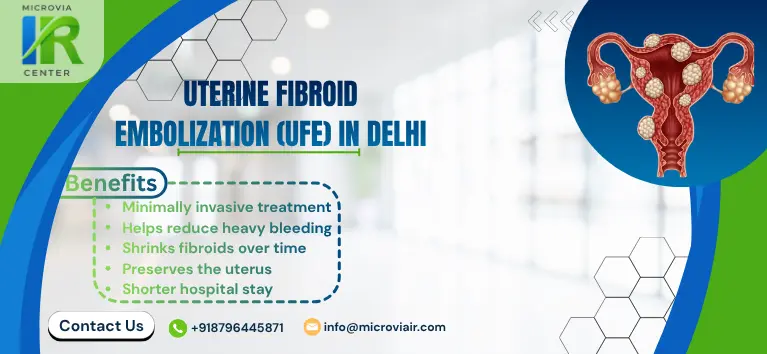
Potential benefits of Uterine Fibroid Embolization (UFE) in Delhi include:
- Minimally invasive treatment
- No large abdominal incision
- Uterus is retained
- Can treat multiple fibroids during one procedure
- Reduced menstrual bleeding in many appropriately selected patients
- Reduction in pressure-related symptoms
- Generally shorter recovery than major open surgery
- No need to remove the uterus
UFE has been studied as an effective option for symptomatic fibroids, although outcomes can vary depending on fibroid characteristics and individual patient factors.
Is UFE suitable for everyone?
No. Treatment selection should be individualized.
A specialist may consider fibroid size, number, location, symptoms, previous treatments, overall health, imaging findings and reproductive plans.
Certain conditions may require alternative treatment or additional evaluation. Women who are pregnant, have active pelvic infection, or have certain unusual fibroid characteristics may not be suitable candidates.
This is why choosing an experienced interventional radiology center is important when considering Uterine Fibroid Embolization (UFE) in Delhi.
UFE Recovery, Comparison and Choosing the Right Treatment
Recovery after UFE
Recovery varies between patients. Some women experience cramping, pelvic discomfort, tiredness, nausea or mild fever-like symptoms during the first few days. These symptoms are commonly managed with medications prescribed by the treating team.
Patients are usually advised to rest initially and gradually return to normal activities according to their doctor’s instructions.
The improvement in symptoms is not always immediate. Menstrual bleeding and pressure symptoms may improve progressively, while fibroid shrinkage occurs over several months.
Follow-up appointments and imaging may be recommended to assess the response to treatment.
UFE vs surgery
| Treatment | Approach | Uterus retained? | Recovery |
| UFE | Minimally invasive embolization | Yes | Generally shorter than major surgery |
| Myomectomy | Surgical removal of fibroids | Yes | Depends on surgical approach |
| Hysterectomy | Surgical removal of uterus | No | Depends on surgical approach |
The best treatment depends on the woman’s symptoms, fibroid characteristics, health, age, and reproductive plans. No single treatment is ideal for every patient.
About Microvia IR Center
Microvia IR Center is an interventional radiology-focused healthcare center providing minimally invasive image-guided procedures. Its approach centers on evaluating patients carefully and selecting appropriate interventional treatments based on their individual clinical needs.
For women considering Uterine Fibroid Embolization (UFE) in Delhi, specialist assessment is important because successful treatment begins with appropriate patient selection and detailed imaging evaluation.
The center’s interventional radiology services may include minimally invasive procedures for conditions such as:
- Uterine fibroids
- Varicose veins
- Prostate-related conditions
- Vascular disorders
- Selected tumors and cancer-related conditions
- Image-guided pain and other interventional procedures
The specific procedure recommended depends on the patient’s diagnosis and clinical evaluation.
FAQs
1. What is Uterine Fibroid Embolization?
Uterine Fibroid Embolization is a minimally invasive procedure that reduces blood flow to uterine fibroids, causing them to gradually shrink.
2. Is UFE a major surgery?
No. UFE is performed through a small arterial access point using a catheter rather than through a large abdominal incision.
3. Is UFE painful?
Some women experience pelvic cramping or discomfort after the procedure. Pain-management medication is generally provided according to individual needs.
4. How long does it take for fibroids to shrink after UFE?
Fibroids generally shrink gradually rather than immediately. The extent and timing of shrinkage vary according to individual fibroid characteristics.
5. Can UFE treat multiple fibroids?
Yes. One advantage of embolization is that multiple fibroids can often be treated during the same procedure when the patient is an appropriate candidate.
6. Can I become pregnant after UFE?
Pregnancy after UFE is possible, but the impact of UFE on fertility and pregnancy should be discussed individually with a gynecologist and interventional radiologist. Women actively planning pregnancy should have a detailed consultation before treatment.
7. Is UFE better than a hysterectomy?
Not necessarily. UFE and hysterectomy have different purposes, advantages, risks and implications. UFE preserves the uterus, whereas hysterectomy removes it. The appropriate choice depends on individual circumstances.
8. How long is recovery after UFE?
Recovery varies. Many patients can gradually resume routine activities within days to a couple of weeks, depending on symptoms and their doctor’s advice.
9. Can fibroids come back after UFE?
UFE treats existing fibroids by reducing their blood supply, but it does not guarantee that new fibroids will never develop. Long-term outcomes vary between patients.
10. How do I choose a center for UFE in Delhi?
Look for an experienced interventional radiology team with appropriate imaging facilities, expertise in embolization, individualized treatment planning, and structured follow-up care.
Conclusion
Uterine Fibroid Embolization (UFE) in Delhi offers a minimally invasive option for appropriately selected women experiencing troublesome symptoms from uterine fibroids. By reducing the blood supply to fibroids, UFE can help them shrink and may improve symptoms such as heavy menstrual bleeding, pelvic pressure and discomfort.
Uterine Fibroid Embolization (UFE) in Delhi should not be selected solely because it is minimally invasive. Proper diagnosis, detailed imaging, assessment of symptoms and consideration of reproductive goals are essential before treatment.
If fibroids are affecting your quality of life, a specialist consultation can help you understand whether UFE, medication, myomectomy, hysterectomy, or another approach is most appropriate for you.
Considering UFE for symptomatic fibroids? Book a consultation with Microvia IR Center to discuss your condition, review your imaging, and understand whether Uterine Fibroid Embolization is an appropriate treatment option for you.
Uterine Fibroid Embolization (UFE) in Delhi can be an important part of a personalized fibroid-care plan when performed after careful evaluation by an experienced interventional radiology team.