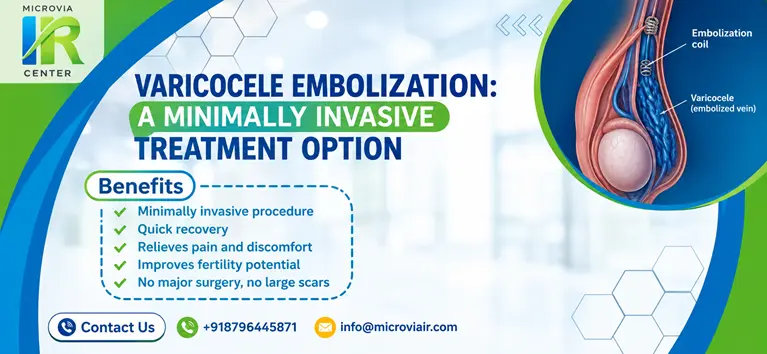
Varicocele is a condition in which the veins around the testicle become enlarged because blood does not drain normally. It is relatively common and may occur without noticeable symptoms. In some men, however, it can cause scrotal discomfort, heaviness, swelling, visible veins, testicular changes, or fertility-related concerns.
For men who require treatment, Varicocele Embolization: A Minimally Invasive Treatment Option can provide an alternative to conventional surgical treatment. It uses a thin catheter and image guidance to block abnormal blood flow through the affected vein, allowing blood to redirect through healthier veins.
Unlike conventional surgery, the procedure does not require a surgical incision in the scrotum. It is generally performed as an outpatient or short-stay procedure, depending on the patient’s condition and treating team’s protocol.
What Is Varicocele?
A varicocele develops when blood collects in the veins responsible for draining the testicle. Problems with venous valves and abnormal blood flow can contribute to enlargement of these veins.
Not every varicocele requires treatment. A specialist may recommend observation when symptoms are minimal. Treatment may be considered when there is persistent pain, testicular changes, fertility concerns, or other clinically significant findings.
Common Symptoms of Varicocele
Some men have no symptoms. When symptoms occur, they may include:
- Dull or aching pain in the scrotum
- A feeling of heaviness or dragging
- Swelling around the testicle
- Enlarged or twisted veins
- Discomfort after prolonged standing or physical activity
- Testicular size changes
- Fertility problems or abnormal semen analysis
Persistent scrotal pain or swelling should be medically evaluated rather than self-diagnosed.
Symptoms, Causes and Diagnosis of Varicocele
Causes and Risk Factors
The exact mechanism can vary, but varicocele is generally associated with abnormal blood flow in the veins draining the testicle. When blood flows backward or becomes congested, pressure within these veins can increase, causing them to enlarge.
The condition is more frequently found on the left side because of differences in venous anatomy. A varicocele may also be associated with prolonged discomfort, testicular changes, or reduced sperm quality in some men.
How Is Varicocele Diagnosed?
Diagnosis generally starts with a medical history and physical examination. The doctor may examine the scrotum while the patient is standing and may ask about pain, fertility concerns, previous treatments, and changes in testicular size.
A scrotal ultrasound with Doppler may be recommended to evaluate the veins and blood flow. For men undergoing fertility evaluation, a semen analysis may also be appropriate.
The diagnosis is important because enlarged veins alone do not necessarily mean that treatment is required. Treatment decisions should consider symptoms, fertility goals, testicular health, examination findings, and imaging results.
When Should Treatment Be Considered?
Treatment may be discussed when a varicocele is associated with:
- Persistent or troublesome scrotal pain
- Fertility concerns
- Abnormal semen parameters
- Testicular growth or size concerns
- Significant discomfort affecting daily activities
- Recurrent varicocele after previous treatment
The appropriate approach depends on individual circumstances. Varicocele Embolization: A Minimally Invasive Treatment Option may be considered for selected patients after specialist assessment.
Is Varicocele Treatment Without Surgery Possible?
Yes. Varicocele Treatment Without Surgery is possible through catheter-based embolization for appropriately selected patients. Instead of surgically exposing and tying off the abnormal veins, embolization closes the problematic venous pathway from inside the blood vessel.
This approach can be particularly useful for patients looking for a minimally invasive treatment or for some patients whose varicocele has returned following previous surgery.
Varicocele Embolization: Procedure, Benefits and Recovery
How Does Varicocele Embolization Work?
Varicocele Embolization: A Minimally Invasive Treatment Option uses a thin catheter to reach the abnormal vein. The procedure is generally performed using local anaesthesia, with sedation when clinically appropriate.
The process usually involves:
- Pre-procedure evaluation: Medical history, examination, ultrasound findings, medications, and other relevant investigations are reviewed.
- Vascular access: The skin is cleaned and numbed. A small access point is made, commonly through a vein in the groin or neck.
- Catheter placement: A thin catheter is guided toward the affected testicular vein using real-time imaging.
- Venography: Contrast may be used to identify the abnormal veins and understand the venous anatomy.
- Embolization: Tiny coils and/or another suitable embolic material are placed to block abnormal blood flow.
- Completion: The catheter is removed and pressure is applied to the small access site.
- Observation: The patient is monitored before discharge according to the treating team’s instructions.
The procedure is generally completed within a short period, although the total treatment time may vary depending on the patient’s condition, vein anatomy, and procedural complexity.
Benefits of Varicocele Embolization
Potential benefits for appropriately selected patients include:
- No conventional surgical incision in the scrotum
- No scrotal stitches
- Small access point
- Minimally invasive treatment
- Generally shorter recovery than conventional surgery
- Minimal visible scarring
- Potentially less post-procedure discomfort
- Usually a short hospital or observation stay
- Option for selected recurrent varicoceles
- May help relieve pain and swelling
- May improve sperm quality in some men
For suitable patients, embolization may help reduce varicocele-related pain and swelling, while improvements in sperm parameters may also occur in some cases.
Recovery After the Procedure
Recovery following Varicocele Embolization: A Minimally Invasive Treatment Option is generally shorter than recovery from conventional surgery, although individual experiences vary.
Some patients may experience mild soreness or a feeling of discomfort around the treated area after the procedure. These symptoms are usually temporary and tend to improve gradually during the recovery period.
Your doctor may recommend:
- Taking prescribed medicines as directed
- Keeping the access site clean and dry
- Avoiding strenuous exercise temporarily
- Following specific lifting restrictions
- Attending follow-up appointments
- Reporting unusual swelling, severe pain, fever, or bleeding promptly
The exact return-to-work and exercise timeline should be based on your doctor’s instructions rather than a fixed timetable.
Possible Risks and Limitations
Although minimally invasive, embolization is still a medical procedure and has potential risks. These can include bruising or bleeding at the access site, infection, contrast-related reactions, blood-vessel injury, temporary discomfort, or unintended embolization. Rare complications can occur.
Not every patient is a candidate. Detailed evaluation of the patient’s symptoms, venous anatomy, fertility goals, previous treatment, and overall health is important before choosing embolization.
Varicocele Embolization vs Conventional Surgery
Both embolization and surgical treatment aim to stop abnormal blood flow through the veins responsible for the varicocele.
Embolization:
- Catheter-based treatment
- Small vascular access point
- No conventional scrotal surgical incision
- Usually short recovery
- Can be considered for selected recurrent cases
Surgical treatment:
- Requires surgical exposure of the affected veins
- Different surgical approaches are available
- May involve an incision
- Recovery depends on the specific surgical technique
There is no single treatment that is appropriate for every patient. The decision should be based on clinical findings, anatomy, fertility considerations, previous treatment, and discussion with the treating specialist.
About Microvia IR Center
Microvia IR Center provides minimally invasive, image-guided treatment options for a range of vascular, tumour, and other medical conditions. The centre offers patient-focused evaluation and treatment using advanced image-guided techniques.
Its services include Varicocele Embolization, Thyroid Nodule Ablation, Uterine Fibroid Embolization, Prostatic Artery Embolization, Liver Tumor Ablation, Kidney Tumor Ablation, Lung Tumor Ablation, Vascular Malformation Treatment, Dialysis Access Interventions, Image-Guided Biopsies, and Pain Management Procedures.
For patients looking for Varicocele Treatment Without Surgery, Microvia IR Center offers evaluation for catheter-based embolization as a minimally invasive treatment option.
Microvia IR Center also lists services such as:
- Varicocele Embolization
- Thyroid Nodule Ablation
- Varicose Vein Treatment
- Uterine Fibroid Embolization
- Prostatic Artery Embolization
- Liver Tumor Ablation
- Kidney Tumor Ablation
- Lung Tumor Ablation
- Vascular Malformation Treatment
- Dialysis Access Interventions
- Image-Guided Biopsies
- Pain Management Procedures
Frequently Asked Questions About Varicocele Embolization
1. What is Varicocele Embolization?
Varicocele embolization is a minimally invasive procedure that blocks abnormal blood flow through enlarged testicular veins using a catheter and embolic materials such as coils. Blood is then redirected through healthier veins.
2. Is Varicocele Treatment Without Surgery Possible?
Yes. Catheter-based embolization provides a non-surgical treatment option for appropriately selected patients. It avoids conventional surgical exposure of the affected veins.
3. Is Varicocele Embolization painful?
The access area is usually numbed with local anaesthesia, and sedation may be used when appropriate. Some patients experience temporary discomfort following the procedure.
4. How long does the procedure take?
The procedure is commonly completed in around one hour, although the duration can vary according to individual anatomy and procedural complexity.
5. Can embolization help with fertility?
A varicocele can be associated with impaired sperm quality in some men. Embolization may improve sperm quality in appropriately selected patients, but fertility outcomes vary and cannot be guaranteed.
6. How soon can I return to normal activities?
Many patients return to routine activities relatively quickly, but the exact timeline depends on the procedure, symptoms, occupation, and doctor’s instructions.
7. Can embolization treat a recurrent varicocele?
It can be considered for selected patients with recurrent varicocele. Previous treatment and the patient’s venous anatomy need to be reviewed before deciding on the appropriate approach.
8. Does every varicocele require treatment?
No. Some varicoceles cause no symptoms and may simply require monitoring. Treatment is considered when there are clinically relevant symptoms, fertility concerns, testicular changes, or other indications.
9. Is Varicocele Embolization: A Minimally Invasive Treatment Option suitable for everyone?
No. A specialist should evaluate your symptoms, examination, ultrasound findings, fertility goals, medical history, and venous anatomy before recommending treatment.
10. Where can I get evaluated for varicocele embolization in Delhi?
Microvia IR Center in East Patel Nagar, New Delhi, provides evaluation and minimally invasive treatment services, including varicocele embolization.
Conclusion
Varicocele Embolization: A Minimally Invasive Treatment Option can be an important treatment choice for appropriately selected men with symptomatic varicocele or fertility-related concerns. By treating the abnormal vein through a small catheter access point, the procedure avoids a conventional surgical incision and may offer a relatively short recovery.
For men considering Varicocele Treatment Without Surgery, proper diagnosis and individualized specialist assessment are essential. Treatment should be selected according to symptoms, testicular health, fertility goals, anatomy, previous treatment, and overall medical condition.
Book an Appointment at Microvia IR Center
If you are experiencing scrotal pain, heaviness, swelling, visible veins, or fertility concerns, consult a specialist to understand whether Varicocele Embolization: A Minimally Invasive Treatment Option is appropriate for you.
Book an appointment with Microvia IR Center, East Patel Nagar, New Delhi, to discuss your symptoms, review your investigations, and understand your available treatment options.